Film nite #20 is a (faintly seedy) music double bill. First up is 'Gainsbourg' (2010), a Serge biopic. Biopics can faul foul of being overly detail-orientated and lacking spark, this film (for me) succeeds due to a decent injection of imagination and is also visually stunning. Much of its success is also down to the superb leads. Eric Elmosnino dazzles as Serge, Lucy Gordon (Birkin) and Laetitia Casta (Bardot) are both perfect, charming and very charismatic. Whilst the film is reasonably accurate in terms of Serge's life, it doesn't slavishly follow the details preferring a more characterful, loose approach, somewhat reflecting the man himself. Oh and it's stylish as fook.
Second up is Dig! (2004). A documentary detailing jaw-dropping levels of ego, rivalry and obsession is about two bands who started off as friends and peers, The Dandy Warhols and The Brian Jonestown Massacre. A righteous-indignation-off unfolds between the two bands, focussing on main protagonists, BJM's frontman, fantasist and a*hole Anton Newcombe and The Dandy's possibly even more odious and opportunistic frontman, Courtney Taylor. The results are both hilarious and appalling in equal measure. Mostly hilarious....
It's the fag end of winter: it's cold and grey; you're skint; you've
not seen the sun for months and your skin is so pale it glows in the
dark. What better counterpoint to this abject misery than some
rollicking, charming and cheeky Ealing comedies: "Kind Hearts and
Coronets" (1949) followed by "The Lavender Hill Mob" (1951).
Both star everyone's cinematic surrogate grandfather, Alec Guiness, on top form.
To fully restore your faith in humankind and the world in general, look out for the scene in Lavender Hill Mob where Stanley Holloway and Alex Guinness are descending the Eiffel Tower - it's magic!
For my third
double-bill, I had to think long and hard about what I would subject my quarry
to. All I knew was that I wanted a geographical theme. Initially, I was bent on
a Scottish sortie, with a brace of the little-seen Orphans (Dir. Peter Mullan, 1998) and Whisky Galore! (Dir. Alexander Mackendrick, 1949). Accidental Hero and Gregory's Girl weren't far behind, Bill Forsyth lovers.
Then it
struck me... "All right, all right, all riiiiiiight." It was time to
resurrect the cinematic tookus of Texas by way of Matthew "two good
films" McConaughey.
Lone Star
(Dir. John Sayles, 1996)
Indie director John Sayle's
most cinematic film to date is also one of his most successful. Ostensibly a whodunit
with a central love story, Lone Star
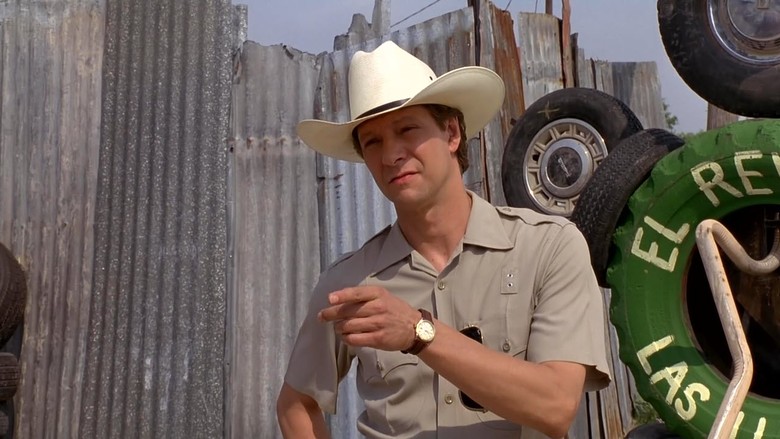
is an ensemble piece in which a small town sheriff, Sam Deeds (Chris Cooper),
must solve the mystery of who murdered the loathsome Charlie Wade (Kris
Kristofferson) many moons ago. The suspect: his late father and legendary
former sheriff, Buddy Deeds (Matthew McConaughey).
Chris Cooper
is absolutely incredible as Sam; understated, compassionate and riddled with
dad issues. It's not often you get to see a character actor lead a film, and
Cooper gives compelling evidence as to why he's so highly regarded by Hollywood
bigwigs and outsiders. But the real star of the show is director John Sayles.
With ace DP Haskell Wexler in tow, Sayles turns the town of Frontera, Texas,
into a real, living and breathing community. It's so palpable that you feel
like you're there with Sam investigating the murder.
Chris Cooper: Either watch Lone Star or spend a night in the cooler - it's your choice.
The dialogue
is nuanced and often majestic, but sometimes the social commentary -
preoccupied with shared history and the need to remember/forget, figuratively
represented by US/Mexican relations within the community - feels forced and
heavy-handed. However, it's striking how similar the beats of the dialogue are
in HBO’s The Wire, which was
definitely influenced by the socially-conscious films of John Sayles.
How more
people haven't seen this film is a riddle that I'll never be able to solve.
Watch it for the tremendous performances, the scintillating dialogue and an
ending that packs a quietly devastating punch not without hope for a better
future. Nice work, John.
Now watch the Lone Star trailer below:
Dazed and
Confused (Dir. Richard Linklater, 1993)
There's not
much to say about Dazed and Confused
that I haven't said elsewhere (you can read my lovingly-written nostalgia piece here). Linklater's masterpiece is one of the best 'day in the life' films
around, and it's definitely the greatest movie about being a teenager.
Set during
the last day of term in 1976, Dazed and
Confused follows the misadventures of freshman Mitch Kramer (Wiley
Wiggins), senior Randy "Pink" Floyd and a whole host of geeks, cool
kids and jocks from end of school to the early hours of the next morning.
From the
brutal high school hazing to the ensuing debauchery of the beer bust, the film
recreates the highs and lows of teenage life with unerring ease and poignancy
without being mawkish or heavy-handed. Linklater knows that teenagers are
naive, self-indulgent arseholes, but that that they can also be great fun, too.
He also knows how to put together a cracking soundtrack, which is very much of mid-seventies
era (read: slightly embarrassing).
Special
mention must go to the man of the article, Matthew McConaughey. Wooderson is
one of my favourite cinematic slackers, simultaneously cool and creepy as the
older guy determined to keep on livin'...L...I...V...I...N. On the other hand, 'Special' mention goes to Wiley Wiggins who spend most of the time clinching the bridge of his nose as though he's just drank too much milkshake. Bloody kids.
Matthew McConaughey, Jason London and Wiley Wiggins: Passing down the baton of cool.
My
university friends and I (mainly film studies students) used to put Dazed and Confused on before we went out
and it regularly brightened up even the gloomiest of evenings trawling the bars
of Sheffield in the winter. If you don't have any friends, I suggest you get a
big bag of weed and light one up in honour of this genuine cult classic, my friend.
You can watch the Dazed and Confused trailer below:
In an effort to unleash the full horror of my mindbox upon my fellow film-watching cohorts, I had to plumb the depths, but instead I got lazy and showed a bunch of clips they've all probably seen before. However, I did try my best to assemble the clips into a vague and wispy narrative.
For the benefit of anyone who wasn't round my house that Saturday, behold what you missed:
1. The Golden Harvest Ident (1972)
Everyone who cares knows that the best idents come from Hong Kong. But what's the king of idents, you ask? Simple, it's the classic Golden Harvest ident circa 1972:
2. The Opening of Dead or Alive (Dir. Takashi Miike, 1999)
Miike veterans are probably chuckling at the prospect of Miike virgins clicking that play button. For the uninitiated, I will try to condense the full magnitude of this clip into one sentence to save your poor little eyes, ears and tummy. Here goes... The opening to Dead or Alive crams several violent murders, beatings, male sodomy, massive cocaine abuse, shotguns, a noodle explosion, pole dancing and Riki Takeuchi looking cool all in six marvelous minutes of rapid-fire cuts and a stonkingly over-the-top Jap rock score. Possibly the greatest opening ever. Come to think of it, the ending isn't exactly quiet.
3. The Intro to The Trap: What Happened to Our Dream of Freedom(Dir. Adam Curtis, 2007)
A startlingly effective attack on our modern day, statistically-powered global democracy as envisioned by Cold War America, The Trap is Adam Curtis' masterwork. This short clip tells you what the series is all about in a much more eloquent fashion, with added John Carpenter synth music:
4. Eastbound and Down Season 1 Episode 2: Work Drugs (Dir. David Gordon Green, 2009)
Definitely one of the best clips from the first series of Eastbound and Down. Washed-up baseball player Kenny 'Fucking' Powers (Danny McBride) tries to win his childhood sweetheart's love at a kids' school disco, with ecstasy-fueled dance moves so crass that you'll almost forget his astonishing mullet (almost):
5. The Wire Season 1 Episode 4: "Fuck" Crime Scene Investigation (Dir. Clément Virgo, 2002)
While most people commend The Wire for it's groundbreaking narrative arcs, gobsmacking insights and it's peerlessly-researched storylines and characters, it first got to me through it's brilliantly black sense of humour. This is best exemplified by this crime scene investigation, with all dialogue between detectives McNulty and "Bunk" Moorland communicated through variations on the word "fuck":
6. Cop Hard Episode 9: Small Packages (Dir. Charles C. Custer, 2011)
Larry Hard is a cop with a raging hard-on for justice. If you try to 'make love' with this perverted moral crusader then you're in for a shock. Riffing on police procedural film and TV tropes, Cop Hard likes to take the joke that little bit too far and that's why I love it. Special kudos goes to Mark 'The Muscle' Winter for channeling the mania of Daniel Day Lewis in such a way that it'll never win him an Oscar. There will be blood in the following clip:
7. Sonatine: the Beach Sumo Scene (Dir. Takeshi Kitano, 1993)
While Sonatine might not be Kitano's most idiosyncratic or outre film, I think it's his most effective. What starts as a conventional gangster flick takes a turn for the transcendental when the narrative makes a Godard-like twist. Holed up in an Okinawan beach hut, a bunch of world-weary yakuza wile away the last few days of their lives playing childish games against a beautiful Pacific backdrop. Probably my favourite film.
P.s. the clip is missing English subs, but you'll get the point:
8. The Pervert's Guide to Cinema: Part 1: "I Want to Fuck Mitch" (Dir. Sophie Fiennes, 2006)
In between his mad-eyed stare and his wild gesticulations, Slavoj Zizek makes some baffling and brilliant observations about cinema and voyeurism. Taken from part 1 of The Pervert's Guide to Cinema, this insightful and humorous little ditty is a highlight, revealing Zizek's not insubstantial madness and penchant for the absurd:
9. The Parallax View: The Test Scene (Dir. Alan J. Pakula, 1974)
The greatest conspiracy thriller ever made, Pakula's masterpiece is a stark and cinematic piece of paranoia combining Cold War hysteria with Manchurian Candidate-style machinations. The underrated Warren Beatty sleuths his way through an increasingly tense series of set pieces as the invisible forces of the Parallax Corporation draw ever closer. This 'brainwashing' scene is the movie at its most subversive - how they mine such dread and emotion out of only a handful of clips and some cynically-produced music is staggering. Whether it really does turn Beatty's character into a card-carrying killer, or just a pawn in a high stakes game played out by a hidden layer of unaccountable conspirators, is up to you:
10. Ringu: The Cursed Video (Dir. Hideo Nakata, 1998)
The most chilling and effective of the late 90s J-horrors, Ringu always scares me with it's preference for atmosphere over narrative and character. It's genius is in implicating the viewer into the horror: I dare anyone to watch this video without worrying about the ensuing curse - prepare for that phone call:
11. Brass Eye Special: Paedophilia: Chris Morris Questions a Paedophile (Dir.Tristram Shapeero, 2001)
We owe a huge debt to Chris Morris for Brass Eye. Arch lampooner of the reactionary right-wing media and idiotic, fame-hungry celebrities, Morris' success means that he'll probably never quite reach the same heights of wrong ever again. Fortunately, we have moments like this to remind us of his cunningly subversive satire, which also happens to be bloody hilarious, too:
12. Sealab 2021: Season 1, Episode 3: Happy Cake (Dirs. Adam Reed & Matt Thompson, 2000)
Adult Swim have featured better TV shows than Sealab 2021, but no character comes close to Captain Murphy (voiced by the late Harry Goz). Murphy breathlessly chews and rambles his way through every episode with the pyschopathic glee of a disturbed man child. Words cannot capture his sheer idiocy and eccentricities. In place of a considered and thoughtful analysis of Captain Murphy's character, I hereby supply you with this episode instead:
13. Patlabor 2: The "Just War/Unjust Peace" Scene (Dir. Mamoru Oshii, 1993)
Good old anime. Sometimes I like nothing better than to switch my brain off and watch Fist of the North Star for the millionth time. But in between the exploding heads, I like to turn my noggin on max power and take in this exemplary political-thriller anime from Mamoru Oshii (Ghost in the Shell). Never mind comparing it to other anime, it's an amazing piece of cinema, exploring complex ideas without overcomplicating or dumbing down it's message. There may be a bit of giant robot action, but Oshii seems far more interested in the human conflict at the heart of this tale of an alternative future where Japan sits on the brink of war. Hats off to Kenji Kawaii for his lovely score:
14. A Touch of Zen: The Buddhist Scene (Dir. King Hu, 1971)
Comparisons to Crouching Tiger, Hidden Dragon are a bit boring by now, so I'll cut straight to the chase and say that this martial arts epic deserves your attention for some well-crafted fight scenes and a series of genre-transcending moments, such as this clip depicting a band of Buddhist monks silently bounding into righteous action:
15. Lonewolf and Cub: Babycart at the River Styx: Ogami Itto Fights the Hidari Brothers (Dir. Kenji Misumi, 1972)
There's something mesmerising about Tomisaburo Wakayama's middle-aged, overweight samurai. But when you see the dilapidated ronin swing into battle, all concerns about his sword-wielding prowess disappear in a whirl of katanas and arterial spray. The Hidari Brothers, characters that inspired John Carpenter's "Three Storms" in Big Trouble in Little China, are pretty tough, but even they get diced up big time. Gloriously staged and soundtracked, this scene features outlandish levels of violence and possibly the most out there final words from a dying man (as you'll discover when I finally work out how to burn the subs):
16. Time Trumpet: Episode 1: Changes (Dir. Armando Iannucci, 2006)
Absent from the UK DVD version due to licencing issues, the denouement to episode one of Time Trumpet features a simultaneously sickening, stupefying and mirth-filled musical number, edited to the sounds of David Bowie's 'Changes'. A fitting way to end this series of clips, I hope you'll agree: